
But do not ignore this one fact, beloved, that with the Lord one day is like a thousand years, and a thousand years are like one day. The Lord is not slow about his promise, as some think of slowness, but is patient with you, not wanting any to perish, but all to come to repentance. But the day of the Lord will come like a thief, and then the heavens will pass away with a loud noise, and the elements will be dissolved with fire, and the earth and everything that is done on it will be disclosed. (II Peter 3:8-10)
In verse 8, Peter alludes to Psalms 90:4 to accentuate that the scoffers of verse 3 ignore that “judgment is God’s business and will be accomplished on God’s schedule.”[1] Peter reassures the reader in verse 9 that God “is patient…not wanting any to perish, but all to come to repentance” and that, in verse 10, “the day of the Lord will come like a thief”.
Later in verse 10, Peter begins to describe the “day of the Lord”. Peter writes that “the heavens will pass away with a loud noise”. The Greek word that is translated “pass away” is παρέρχλέω (parerchomai) which is better translated as “come near”. This passage seems to be referring to the parousia as opposed to destruction. This can be supported by I Thessalonians 4:16, “The Lord himself shall descend from heaven, with a shout, with the voice of the archangel, and with the trump of God.” If παρέρχλέω is better translated as “come near” then this gives addition support to the thesis that “fire” signifies the presence of the God. The auf/gabe of God “comes near”[2]; God is present.
Peter’s next description of the “day of judgment” is that “the elements will be dissolved with fire.” Here in verse 10, “dissolved” is from the Greek λύω (luo) which literally means “loosed”. In Luke 13:12, λύω is translated as “set free”. Why “set free” in Luke and “dissolved” in II Peter 3:10? This could be explained by returning to the discussion above concerning Paul’s description of “the Day” in I Corinthians 3. This dissolving/loosing fire in II Peter 3:10 may be similar to the revealing/burning fire of which Paul is writing. Either the “elements” are tested and survive the fire and are “loosed” or they are tested, found wanting, and are “dissolved”. If II Peter is referring to the destruction of Jerusalem and the Temple in 70 A.D., as introduced above, we find, historically, that the Temple was destroyed.
In the subsequent phrase, Peter writes that “the earth and everything that is done on it will be disclosed.”[3] Other versions of the Bible translate this passage differently; the New American Standard[4] and the New Jerusalem Bible[5] read, “will be burned up”, the KJV[6], “shall burn up”, and the NIV[7], “will be laid bare.” The Textus Receptus[8] uses the verb κατακαεσεται (katakaesetai) as the Greek word for “burned up” and this is used in all Bible translation of the sixteenth and seventeenth centuries, including the King James Version in 1611. The Textus Receptus translation was soon rejected, due to the discovery and publication of Codex Sinaiticus and Codex Vaticanus, both uncial manuscripts of the fourth century. In these texts, the verb used in this verse is εύρεστεσεται (heuresthesetai), “will be found”.[9] If “will be found” is more accurate, this strengthens the connection between II Peter 3:10 and I Corinthians 3:11-15.
[1] Fred B. Craddock, First and Second Peter and Jude, Westminster Bible Companion, Westminster John Knox Press, 1995, 120.
[2] See Nik Ansell’s commentary on Colossians 3:1f in Third Way, February 1999, 12. “Sometimes, heaven and God become almost synonymous – so Matthew uses the term ‘the kingdom of heaven’ where Mark and Luke refer to ‘the kingdom of God’.”
[3] NRSV text note: “Other ancient authorities read will be burned up”.
[4] New American Standard Bible, The Lockman Foundation, 1995. NASB text note: “Two early mss read discovered”.
[5] The New Jerusalem Bible, Doubleday, 1985.
[6] The Authorized King James Version, 1611.
[7] New International Version. NIV text note: “Some manuscripts be burned up”.
[8] “Received Text”. First published in 1516.
[9]Albert M. Wolters, “Worldview and Textual Criticism in 2 Peter 3:10”, Westminster Theological Journal, 49.2, 1987, 405-413.
Tuesday, January 10, 2006


Monday, January 09, 2006
The Late, Great Planet Jerusalem: A Historical, Canonical Reading of II Peter 3(Part I)
This is now, beloved, the second letter I am writing to you; in them I am trying to arouse your sincere intention by reminding you that you should remember the words spoken in the past by the holy prophets, and the commandment of the Lord and Savior spoken through your apostles. First of all you must understand this, that in the last days scoffers will come, scoffing and indulging their own lusts and saying, "Where is the promise of his coming? For ever since our ancestors died, all things continue as they were from the beginning of creation!" They deliberately ignore this fact, that by the word of God heavens existed long ago and an earth was formed out of water and by means of water, through which the world of that time was deluged with water and perished. But by the same word the present heavens and earth have been reserved for fire, being kept until the day of judgment and destruction of the godless. (II Peter 3:1-7)[1]
In this passage, the purpose of II Peter 3 is revealed. Peter is writing to combat “scoffers” who question the παρουσία (parousia) of Christ due to its supposed delay. The preponderance of English translations interpret παρουσία as “coming”, but, παρουσία (literally “with being”) would be better translated as “presence”. This may appear, presently, as an argument over epiphoric semiotics, however, translating παρουσία more accurately as “presence” has discursive implications later in this passage particularly in verse 7, where we read that “the present heavens and earth are reserved for fire…”
Reading verse 7 in its canonical context, “fire”, throughout both the Old and New Testaments, refers to the divine presence of God. In the Old Testament, אש (‘esh) refers to the presence of God in the burning bush in Exodus 3:2, in the pillar of fire in Exodus 13:21, consuming the burnt offerings in Leviticus 9:24, God is called a “consuming fire” in Deuteronomy 4:24, Micah 1:3-4 reads that “the Lord is coming out of his place…[and that] mountains will melt under him and the valleys will burst open, like wax near a fire”, and Malachi describes God as a “refiner’s fire” in 3:2. Likewise, in the New Testament the divine presence of God is signified by “fire” (πυρ). In Matthew 3:11, God is symbolized as “unquenchable fire”, in I Thessalonians 5:19, Paul writes “Do not put out the Spirit’s fire (NIV[2]), and in Hebrews 12:29, “consuming fire” is used as a metaphor for God. Therefore, it seems that in this discussion of the parousia in II Peter 3, “fire” can be read as referring to the presence of God.
There is, however, another biblical use of “fire”; to signify God’s judgment. This metaphor is used extensively throughout the Old Testament[3]. “Fire” is also used to signify God’s judgment in the apocalyptic literature of the New Testament including Jude Revelation, and II Peter.
The question, then, is whether this use of “fire” in II Peter 3 refers to God’s judgment or God’s divine presence. However, canonically the use of the word “fire” gives the impression that it can refer both to God’s judgment and to God’s divine presence; for example Malachi 3:1-6 and 4:1-6. Therefore, the use of the word “fire” in II Peter 3 has a binary metaphorical meaning signifying both God’s judgment and God’s divine presence.
This, then, concerning the “day of judgment” of verse 7, begs the questions; when, where, upon what and upon whom is this judging presence of God centered? Traditionally, the answer has been that this “day of judgment” is centered upon the entire Creation at the eschaton. However, if II Peter was written prior to the destruction of Jerusalem and the Temple in 70 A.D. (as I believe that it was), then this judgment would, seemingly, be directed at Jerusalem and the Temple. Upon an initially reading, Peter’s phrase “the present heavens and earth are reserved for fire…” in verse 7 would seem problematic, but, read in their canonical context, they can be interpreted to support this claim. In the Old Testament, Jerusalem “is viewed as a microcosm of the whole world, its Temple representing the very structure of creation.”[4] Perhaps the example of this that is most similar to the present study would be found in the book of Isaiah. Isaiah 24:1 reads, “Now the LORD is about to lay waste the earth and make it desolate…” A prominent interpretation of Isaiah posits that when Isaiah refers to judgment on the “earth” he is no longer referring to the destruction of Jerusalem in 587-586 B.C.E., but is then shifting to an eschatological prophecy. The note on chapters 24-27 in The Jewish Study Bible reads, “These [chapters] form a distinct section within the book of Isaiah. They refer to no specific historical situation but are concerned instead with a future time in which the world will undergo sweeping devastation, after which redemption will come to survivors from all the nations.”[5] However, the text does not seem to support such an anachronistic interpretation. Isaiah 1-39 is a prophetic passage concerning the impinging destruction of Jerusalem and the Temple at the hands of Babylonians under Nebuchadnezzar in 587-586 B.C.E.[6]. As Walter Brueggemann writes, “It is Jerusalem that is under judgment and that draws the negating attention of Yahweh.”[7] Elsewhere, Brueggemann writes of chapters 1-39; “In these chapters we are made aware that God will judge the city and its wayward economic and military policies, which are rooted in unfaith.”[8] Jerusalem, in the book of Isaiah, is viewed as a microcosm “representing the whole creation in its hostility toward God”[9]. Therefore, judgment on Jerusalem is judgment on the whole Creation. The destruction of Jerusalem and the Temple in 587-586 B.C.E., of which Isaiah prophesizes, will have “cosmic implications.”[10] Thus, when Isaiah writes that ““Now the LORD is about to lay waste the earth and make it desolate…” in 24:1, he has not redirected his focus from his prophecy of Jerusalem’s imminent destruction onto some eschatological event. He has, however, simply articulated the attitude of his contemporary audience concerning Jerusalem and the Temple. Returning to II Peter 3, “the present heavens and earth” that “have been reserved for fire” refers to a similar, but separate, historical and canonical event; God’s judgment upon Jerusalem (“as a microcosm of the whole world”) and the Temple (“representing the very structure of creation”) in 70 A.D. [11].
Finally, Peter states that this “day of judgment” is coupled with “the destruction of the godless.” In Paul’s discussion of “the Day” in I Corinthians 3:11-15, he writes,
For no one can lay any foundation other than the one that has been laid; that foundation is Jesus Christ. Now if anyone builds on the foundation with gold, silver, precious stones, wood, hay, straw—the work of each builder will become visible, for the Day will disclose it, because it will be revealed with fire, and the fire will test what sort of work each has done. If what has been built on the foundation survives, the builder will receive a reward. If the work is burned up, the builder will suffer loss; the builder will be saved, but only as through fire.
Therefore, reading II Peter in its canonical context, following I Corinthians, “the Day” is less a day of destruction of godless humans and more a day of revelation of the quality of humanity’s work. Paul points out that the godless “work is burned up” and that “the builder will suffer loss”, nevertheless, “the builder will be saved”.
[1] All Scripture quotations are from the NRSV unless otherwise noted. New Revised Standard Version Bible, Division of Christian Education of the National Council of the Churches of Christ in the United States of America, 1989.
[2] New International Version, International Bible Society, 1973.
[3] See Genesis 19:24, Deuteronomy 9:3, 13:12-18, 32:15-43, Joshua 6:24, 8:8; 19, 11:6,9,11, Judges 1:8, 2 Kings 2:11, 6:17, Job 15:34, 20:26, Psalm 11:5-6, 18:6ff, 21:9, 50:3-6, 68:2, 78:21, 79:5ff, 83:14-18, 97:3ff, Isaiah 1:7, 5:24-25, 9:5, 10:16-19, 26:11, 29:6, 30:27-33, 31:9, 33:11-12, 33:13-15, 34:1-10, 47:14, 64:1-11, 66:15-24, Jeremiah 4:4, 15:14, 17:1-4, 27, 21:10-14, 34:2, 22, 37:8, 10, 38:17, 18, 23, 43:12-13, 48:45, 50:32, 51:58, 52:13, Lamentations 2:3-4, 4:11, Ezekiel 5:4, 10:2, 15:1-8, 19:10-14, 20:45-49, 21:28-32, 22:17-22, 23:25, 24:9-14, 28:18-19, 30:6-9,14,16, 36:5-7, 38:17-23, 39:6, Daniel 7:9-12, Hosea 8:14, Joel 1:19-20, Joel 2:3,5, 2:30, Amos 1-2:5, 5:6, Obadiah 18, Micah 1:2-7, Nahum 1:5-6, 3:13-15, Habakkuk 2:13, Zephaniah 1:14-18, 3:8, Zechariah 2:5-13, 3:2, 13:9, Malachi 3:1-6, 4:1-6.
[4] Nicholas John Ansell, “An Apocalyptic Appendix”, The Annihilation of Hell: Universal Salvation and the Redemption of Time in the Eschatology of Jürgen Moltmann, ICS, 2005, 413.
[5] The Jewish Study Bible, Tanakh Translation, Oxford University Press, 2004, 829.
[6] Hershel Shanks ed,. Ancient Israel: From Abraham to the Roman Destruction of Temple, Bible Archaeology Society, 1999, 199.
[7] Walter Brueggemann, Isaiah 1-39, Westminster Bible Companion, Westminster John Knox Press, 1998, 2 and Walter Brueggemann, Isaiah 40-66, Westminster Bible Companion, Westminster John Know Press, 1998, 2. Emphasis Brueggemann’s.
[8] Walter Brueggemann, Isaiah, The Renovaré Spiritual Formation Bible, Harper San Francisco, 2005, 982.
[9] Ansell, “An Apocalyptic Appendix”, 415.
[10] Ansell, “An Apocalyptic Appendix”, 413.
[11] Ansell, “An Apocalyptic Appendix”, 413.
In this passage, the purpose of II Peter 3 is revealed. Peter is writing to combat “scoffers” who question the παρουσία (parousia) of Christ due to its supposed delay. The preponderance of English translations interpret παρουσία as “coming”, but, παρουσία (literally “with being”) would be better translated as “presence”. This may appear, presently, as an argument over epiphoric semiotics, however, translating παρουσία more accurately as “presence” has discursive implications later in this passage particularly in verse 7, where we read that “the present heavens and earth are reserved for fire…”
Reading verse 7 in its canonical context, “fire”, throughout both the Old and New Testaments, refers to the divine presence of God. In the Old Testament, אש (‘esh) refers to the presence of God in the burning bush in Exodus 3:2, in the pillar of fire in Exodus 13:21, consuming the burnt offerings in Leviticus 9:24, God is called a “consuming fire” in Deuteronomy 4:24, Micah 1:3-4 reads that “the Lord is coming out of his place…[and that] mountains will melt under him and the valleys will burst open, like wax near a fire”, and Malachi describes God as a “refiner’s fire” in 3:2. Likewise, in the New Testament the divine presence of God is signified by “fire” (πυρ). In Matthew 3:11, God is symbolized as “unquenchable fire”, in I Thessalonians 5:19, Paul writes “Do not put out the Spirit’s fire (NIV[2]), and in Hebrews 12:29, “consuming fire” is used as a metaphor for God. Therefore, it seems that in this discussion of the parousia in II Peter 3, “fire” can be read as referring to the presence of God.
There is, however, another biblical use of “fire”; to signify God’s judgment. This metaphor is used extensively throughout the Old Testament[3]. “Fire” is also used to signify God’s judgment in the apocalyptic literature of the New Testament including Jude Revelation, and II Peter.
The question, then, is whether this use of “fire” in II Peter 3 refers to God’s judgment or God’s divine presence. However, canonically the use of the word “fire” gives the impression that it can refer both to God’s judgment and to God’s divine presence; for example Malachi 3:1-6 and 4:1-6. Therefore, the use of the word “fire” in II Peter 3 has a binary metaphorical meaning signifying both God’s judgment and God’s divine presence.
This, then, concerning the “day of judgment” of verse 7, begs the questions; when, where, upon what and upon whom is this judging presence of God centered? Traditionally, the answer has been that this “day of judgment” is centered upon the entire Creation at the eschaton. However, if II Peter was written prior to the destruction of Jerusalem and the Temple in 70 A.D. (as I believe that it was), then this judgment would, seemingly, be directed at Jerusalem and the Temple. Upon an initially reading, Peter’s phrase “the present heavens and earth are reserved for fire…” in verse 7 would seem problematic, but, read in their canonical context, they can be interpreted to support this claim. In the Old Testament, Jerusalem “is viewed as a microcosm of the whole world, its Temple representing the very structure of creation.”[4] Perhaps the example of this that is most similar to the present study would be found in the book of Isaiah. Isaiah 24:1 reads, “Now the LORD is about to lay waste the earth and make it desolate…” A prominent interpretation of Isaiah posits that when Isaiah refers to judgment on the “earth” he is no longer referring to the destruction of Jerusalem in 587-586 B.C.E., but is then shifting to an eschatological prophecy. The note on chapters 24-27 in The Jewish Study Bible reads, “These [chapters] form a distinct section within the book of Isaiah. They refer to no specific historical situation but are concerned instead with a future time in which the world will undergo sweeping devastation, after which redemption will come to survivors from all the nations.”[5] However, the text does not seem to support such an anachronistic interpretation. Isaiah 1-39 is a prophetic passage concerning the impinging destruction of Jerusalem and the Temple at the hands of Babylonians under Nebuchadnezzar in 587-586 B.C.E.[6]. As Walter Brueggemann writes, “It is Jerusalem that is under judgment and that draws the negating attention of Yahweh.”[7] Elsewhere, Brueggemann writes of chapters 1-39; “In these chapters we are made aware that God will judge the city and its wayward economic and military policies, which are rooted in unfaith.”[8] Jerusalem, in the book of Isaiah, is viewed as a microcosm “representing the whole creation in its hostility toward God”[9]. Therefore, judgment on Jerusalem is judgment on the whole Creation. The destruction of Jerusalem and the Temple in 587-586 B.C.E., of which Isaiah prophesizes, will have “cosmic implications.”[10] Thus, when Isaiah writes that ““Now the LORD is about to lay waste the earth and make it desolate…” in 24:1, he has not redirected his focus from his prophecy of Jerusalem’s imminent destruction onto some eschatological event. He has, however, simply articulated the attitude of his contemporary audience concerning Jerusalem and the Temple. Returning to II Peter 3, “the present heavens and earth” that “have been reserved for fire” refers to a similar, but separate, historical and canonical event; God’s judgment upon Jerusalem (“as a microcosm of the whole world”) and the Temple (“representing the very structure of creation”) in 70 A.D. [11].
Finally, Peter states that this “day of judgment” is coupled with “the destruction of the godless.” In Paul’s discussion of “the Day” in I Corinthians 3:11-15, he writes,
For no one can lay any foundation other than the one that has been laid; that foundation is Jesus Christ. Now if anyone builds on the foundation with gold, silver, precious stones, wood, hay, straw—the work of each builder will become visible, for the Day will disclose it, because it will be revealed with fire, and the fire will test what sort of work each has done. If what has been built on the foundation survives, the builder will receive a reward. If the work is burned up, the builder will suffer loss; the builder will be saved, but only as through fire.
Therefore, reading II Peter in its canonical context, following I Corinthians, “the Day” is less a day of destruction of godless humans and more a day of revelation of the quality of humanity’s work. Paul points out that the godless “work is burned up” and that “the builder will suffer loss”, nevertheless, “the builder will be saved”.
[1] All Scripture quotations are from the NRSV unless otherwise noted. New Revised Standard Version Bible, Division of Christian Education of the National Council of the Churches of Christ in the United States of America, 1989.
[2] New International Version, International Bible Society, 1973.
[3] See Genesis 19:24, Deuteronomy 9:3, 13:12-18, 32:15-43, Joshua 6:24, 8:8; 19, 11:6,9,11, Judges 1:8, 2 Kings 2:11, 6:17, Job 15:34, 20:26, Psalm 11:5-6, 18:6ff, 21:9, 50:3-6, 68:2, 78:21, 79:5ff, 83:14-18, 97:3ff, Isaiah 1:7, 5:24-25, 9:5, 10:16-19, 26:11, 29:6, 30:27-33, 31:9, 33:11-12, 33:13-15, 34:1-10, 47:14, 64:1-11, 66:15-24, Jeremiah 4:4, 15:14, 17:1-4, 27, 21:10-14, 34:2, 22, 37:8, 10, 38:17, 18, 23, 43:12-13, 48:45, 50:32, 51:58, 52:13, Lamentations 2:3-4, 4:11, Ezekiel 5:4, 10:2, 15:1-8, 19:10-14, 20:45-49, 21:28-32, 22:17-22, 23:25, 24:9-14, 28:18-19, 30:6-9,14,16, 36:5-7, 38:17-23, 39:6, Daniel 7:9-12, Hosea 8:14, Joel 1:19-20, Joel 2:3,5, 2:30, Amos 1-2:5, 5:6, Obadiah 18, Micah 1:2-7, Nahum 1:5-6, 3:13-15, Habakkuk 2:13, Zephaniah 1:14-18, 3:8, Zechariah 2:5-13, 3:2, 13:9, Malachi 3:1-6, 4:1-6.
[4] Nicholas John Ansell, “An Apocalyptic Appendix”, The Annihilation of Hell: Universal Salvation and the Redemption of Time in the Eschatology of Jürgen Moltmann, ICS, 2005, 413.
[5] The Jewish Study Bible, Tanakh Translation, Oxford University Press, 2004, 829.
[6] Hershel Shanks ed,. Ancient Israel: From Abraham to the Roman Destruction of Temple, Bible Archaeology Society, 1999, 199.
[7] Walter Brueggemann, Isaiah 1-39, Westminster Bible Companion, Westminster John Knox Press, 1998, 2 and Walter Brueggemann, Isaiah 40-66, Westminster Bible Companion, Westminster John Know Press, 1998, 2. Emphasis Brueggemann’s.
[8] Walter Brueggemann, Isaiah, The Renovaré Spiritual Formation Bible, Harper San Francisco, 2005, 982.
[9] Ansell, “An Apocalyptic Appendix”, 415.
[10] Ansell, “An Apocalyptic Appendix”, 413.
[11] Ansell, “An Apocalyptic Appendix”, 413.
Thursday, December 15, 2005
"The Magnificat" and the Scandal of Christmas
Remember Mary's Song, "The Magnificat" (Luke 1:46-53), this Christmas: "My soul magnifies the Lord, and my spirit rejoices in God my Savior, for he has looked with favor on the lowliness of his servant. Surely, from now on all generations will call me blessed; for the Mighty One has done great things for me, and holy is his name. His mercy is for those who fear him from generation to generation. He has shown strength with his arm; he has scattered the proud in the thoughts of their hearts. He has brought down the powerful from their thrones, and lifted up the lowly; he has filled the hungry with good things, and sent the rich away empty."
This Christmas season, let's stop the irrelevant cries against the supposed scandal of Christmas, the secular oppression of taking Christ out of Christmas and instead seek to right true injustice such as the budget proposed by the House of Representatives that cuts food stamps, health care, child support, and educational assistance to low-income families - while further lowering taxes for the wealthiest Americans and increasing the deficit for all of our grandchildren. Or to feed those who go hungry. Or to warm those without housing. This is the true scandal of Christmas, Christians turning the blind eye to "the least of these" who Christ particularly told us to care for. As the "Body of Christ" let's begin lifting up the lowly and filling the hungry with good things this Christmas season. This is what Christmas is all about, at least it is what Christ was all about. What is the real scandal of Christmas?
This Christmas season, let's stop the irrelevant cries against the supposed scandal of Christmas, the secular oppression of taking Christ out of Christmas and instead seek to right true injustice such as the budget proposed by the House of Representatives that cuts food stamps, health care, child support, and educational assistance to low-income families - while further lowering taxes for the wealthiest Americans and increasing the deficit for all of our grandchildren. Or to feed those who go hungry. Or to warm those without housing. This is the true scandal of Christmas, Christians turning the blind eye to "the least of these" who Christ particularly told us to care for. As the "Body of Christ" let's begin lifting up the lowly and filling the hungry with good things this Christmas season. This is what Christmas is all about, at least it is what Christ was all about. What is the real scandal of Christmas?
Tuesday, December 13, 2005
The High Cost of Low Prices

WAL-MART: THE HIGH COST OF LOW PRICE is a feature length documentary that uncovers a retail giant's assault on families and American values.
The film dives into the deeply personal stories and everyday lives of families and communities struggling to fight a goliath. A working mother is forced to turn to public assistance to provide healthcare for her two small children. A Missouri family loses its business after Wal-Mart is given over $2 million to open its doors down the road. A mayor struggles to equip his first responders after Wal-Mart pulls out and relocates just outside the city limits. A community in California unites, takes on the giant, and wins!
Producer/Director Robert Greenwald and Brave New Films take you on an extraordinary journey that will change the way you think, feel -- and shop.
Read some breathtaking statistics at: http://www.walmartmovie.com/facts.php
Friday, December 09, 2005
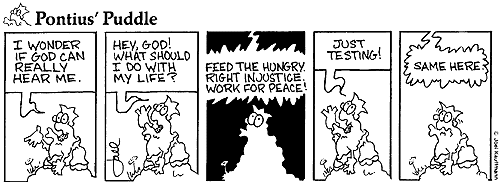

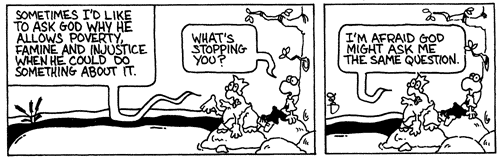
Monday, December 05, 2005
Christian Peacemaker Teams: Committed to Reducing Violence by "Getting in the Way"
On November 29th, the Christian Peacemaker Teams (CPT) confirmed that the four human rights workers who were reported missing in Baghdad on November 26 were associated with CPT.
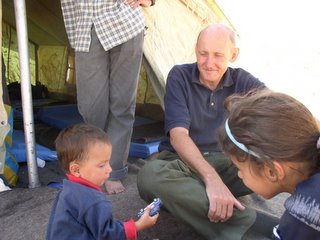 Tom Fox, age 54, is from Clearbrook, Virginia and is a dedicated father of two children. For the past two years, Mr. Fox has worked with CPT in partnership with Iraqi human rights organizations to promote peace. Mr. Fox has been faithful in the observance of Quaker practice for 22 years. While in Iraq, he sought a more complete understanding of Islamic cultural richness. He is committed to telling the truth to U.S. citizens about the horrors of war and its effects on ordinary Iraqi civilians and families as a result of U.S. policies and practices. Mr. Fox is an accomplished musician. He plays the bass clarinet and the recorder and he loves to cook. He has also worked as a professional grocer. Mr. Fox devotes much of his time to working with children. He has served as an adult leader of youth programs and worked at a Quaker camp for youth. He has facilitated young people's participation in opposing war and violence. Mr. Fox is a quiet and peaceful man, respectful of everyone, who believes that "there is that of God in every person" which is why work for peace is so important to him.
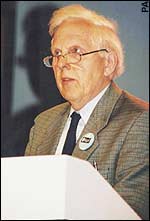 Norman Kember, age 74, is from London, England. He and his wife of 45 years have two married daughters and a 3-year old grandson. He has been a pacifist all his life beginning with his work in a hospital instead of National Service at age 18. Before his retirement he was a professor teaching medical students at St Bartholemew's Hospital in London. He is well known as a peace activist, and has been involved in several peace groups. For the past 10 years he has volunteered with a local program providing free food to the homeless. He likes walking, birdwatching, and writing humorous songs and sketches. In his younger days he enjoyed mountaineering.
 James Loney, 41, is a community worker from Toronto, Canada. He has been a member of Christian Peacemaker Teams since August 2000, and is currently the Program Coordinator for CPT Canada. On previous visits to Iraq, his work focused on taking testimonies from families of detainees for CPT's report on detainee abuse, and making recommendations for securing basic legal rights. James was leading the November 2005 delegation in Iraq when he went missing. James is a peace activist, writer, trained mediator, and works actively with two Toronto community conflict resolution services. He has spent many years working to provide housing and support for homeless people. In a personal statement from James to CPT, he writes: “I believe that our actions as a people of peace must be an expression of hope for everyone. My hope in practising non-violence is that I can be a conduit for the transformative power of God's love acting upon me as much as I hope it will act upon others around me.”
 Harmeet Singh Sooden, 32 is a Canadian electrical engineer from Montreal. He studdied at McGill University and is now working on a masters degree in English literature inAuckland University in New Zealand to prepare for a teaching career. He enjoys art, is active in squash and worked part time as a local squash coach. His family describes him as peaceful and fun-loving and he is known to be passionate about the plight of the underprivileged around the globe. He works tirelessly in his spare time to educate and help others.
This organization is committed to peaceableness, understands that violence does not lead to peace, and is comprised of people who are willing to risk their lives for peace. They ask the question: "What would happen if Christians devoted the same discipline and self-sacrifice to nonviolent peacemaking that armies devote to war?" Which sounds similar to Berry's closing paragraph in "A Citizen's Response", "We can no longer afford to confuse peaceablility with passivity. Authentic peace is no more passive than war. Like war, it calls for discipline and intelligence and strength of character, though it calls also for higher principles and aims. If we are serious about peace, then we must work for it as ardently, seriously, continuously, carefully, and bravely as we have ever prepared for war."
Check out the website at www.cpt.org and especially the Testimonies of Human Rights Abuses at http://www.cpt.org/iraq/iraqtestimonies.php.
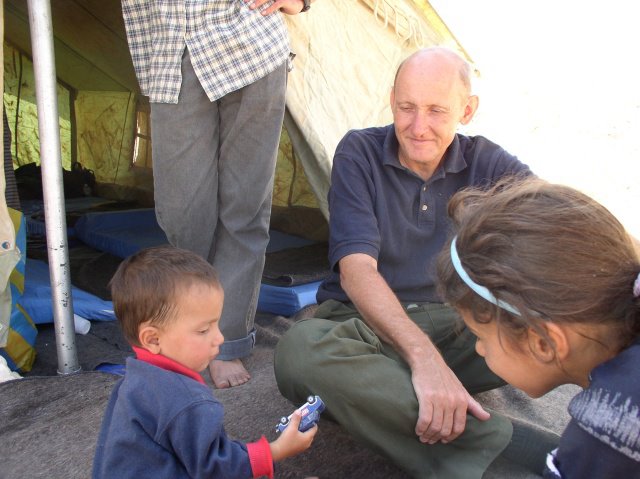 Tom Fox, age 54, is from Clearbrook, Virginia and is a dedicated father of two children. For the past two years, Mr. Fox has worked with CPT in partnership with Iraqi human rights organizations to promote peace. Mr. Fox has been faithful in the observance of Quaker practice for 22 years. While in Iraq, he sought a more complete understanding of Islamic cultural richness. He is committed to telling the truth to U.S. citizens about the horrors of war and its effects on ordinary Iraqi civilians and families as a result of U.S. policies and practices. Mr. Fox is an accomplished musician. He plays the bass clarinet and the recorder and he loves to cook. He has also worked as a professional grocer. Mr. Fox devotes much of his time to working with children. He has served as an adult leader of youth programs and worked at a Quaker camp for youth. He has facilitated young people's participation in opposing war and violence. Mr. Fox is a quiet and peaceful man, respectful of everyone, who believes that "there is that of God in every person" which is why work for peace is so important to him.
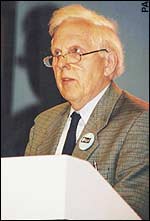 Norman Kember, age 74, is from London, England. He and his wife of 45 years have two married daughters and a 3-year old grandson. He has been a pacifist all his life beginning with his work in a hospital instead of National Service at age 18. Before his retirement he was a professor teaching medical students at St Bartholemew's Hospital in London. He is well known as a peace activist, and has been involved in several peace groups. For the past 10 years he has volunteered with a local program providing free food to the homeless. He likes walking, birdwatching, and writing humorous songs and sketches. In his younger days he enjoyed mountaineering.
 James Loney, 41, is a community worker from Toronto, Canada. He has been a member of Christian Peacemaker Teams since August 2000, and is currently the Program Coordinator for CPT Canada. On previous visits to Iraq, his work focused on taking testimonies from families of detainees for CPT's report on detainee abuse, and making recommendations for securing basic legal rights. James was leading the November 2005 delegation in Iraq when he went missing. James is a peace activist, writer, trained mediator, and works actively with two Toronto community conflict resolution services. He has spent many years working to provide housing and support for homeless people. In a personal statement from James to CPT, he writes: “I believe that our actions as a people of peace must be an expression of hope for everyone. My hope in practising non-violence is that I can be a conduit for the transformative power of God's love acting upon me as much as I hope it will act upon others around me.”
 Harmeet Singh Sooden, 32 is a Canadian electrical engineer from Montreal. He studdied at McGill University and is now working on a masters degree in English literature inAuckland University in New Zealand to prepare for a teaching career. He enjoys art, is active in squash and worked part time as a local squash coach. His family describes him as peaceful and fun-loving and he is known to be passionate about the plight of the underprivileged around the globe. He works tirelessly in his spare time to educate and help others.
This organization is committed to peaceableness, understands that violence does not lead to peace, and is comprised of people who are willing to risk their lives for peace. They ask the question: "What would happen if Christians devoted the same discipline and self-sacrifice to nonviolent peacemaking that armies devote to war?" Which sounds similar to Berry's closing paragraph in "A Citizen's Response", "We can no longer afford to confuse peaceablility with passivity. Authentic peace is no more passive than war. Like war, it calls for discipline and intelligence and strength of character, though it calls also for higher principles and aims. If we are serious about peace, then we must work for it as ardently, seriously, continuously, carefully, and bravely as we have ever prepared for war."
Check out the website at www.cpt.org and especially the Testimonies of Human Rights Abuses at http://www.cpt.org/iraq/iraqtestimonies.php.
Saturday, December 03, 2005
The Canadian Prohibition and the Rise of the Speakeasy?
In November 2004, the New Democratic Party (NDP) introduced a bill in the Canadian Parliament which would effectively ban trans fats. Click here to read the bill. In response to this initiative, the House of Commons by 193 to 73 passed a motion calling for the establishment of the task force, followed by regulations or a law to limit trans-fat content in all food products. Click here to read the motion and to see how each M.P. voted.
As a direct result of the NDP's initiative, the Canadian Government health ministry, Health Canada, announced the formation of a task force to "develop recommendations and strategies for reducing trans fats in Canadian foods to the lowest levels possible." Click here to read the government announcement.
The NDP's initiative originated with the work of Pat Martin, M.P., the primary anti-trans fat advocate in Canada. NDP leader, Jack Layton, M.P. introduced the motion in the House of Commons and has taken this issue forward with Pat Martin.
Canadian MP Pat Martin,dedicated anti-trans fat campaigner
Incidentally, we have provided information and support to Pat Martin and his excellent staff and will continue to do so.
In August 2005, the Trans Fat Task Force created by the Canadian Government health ministry issued an interim report. Click here to read the report. Click here to read the Canadian Government's response to the interim report.
Will this change due to the declaration of "no confidence" and the upcoming election?
If the newly elected officials pick this up where the liberals left off, will this be the Canadian version of the Prohibition? Will Canadians establish and frequent Speakeasy's to enjoy apple danishes, battered fish, pizza, tubs of lard, or anything else dripping with partially hydrogenated oil?
In a country that helps drug addicts inject, made up an official national greeting ("cheemo") that didn't catch on, and attempts to ban trans fats...time will tell, but anything is possible (and the trip there promises to be interesting).
As a direct result of the NDP's initiative, the Canadian Government health ministry, Health Canada, announced the formation of a task force to "develop recommendations and strategies for reducing trans fats in Canadian foods to the lowest levels possible." Click here to read the government announcement.
The NDP's initiative originated with the work of Pat Martin, M.P., the primary anti-trans fat advocate in Canada. NDP leader, Jack Layton, M.P. introduced the motion in the House of Commons and has taken this issue forward with Pat Martin.
Canadian MP Pat Martin,dedicated anti-trans fat campaigner
Incidentally, we have provided information and support to Pat Martin and his excellent staff and will continue to do so.
In August 2005, the Trans Fat Task Force created by the Canadian Government health ministry issued an interim report. Click here to read the report. Click here to read the Canadian Government's response to the interim report.
Will this change due to the declaration of "no confidence" and the upcoming election?
If the newly elected officials pick this up where the liberals left off, will this be the Canadian version of the Prohibition? Will Canadians establish and frequent Speakeasy's to enjoy apple danishes, battered fish, pizza, tubs of lard, or anything else dripping with partially hydrogenated oil?
In a country that helps drug addicts inject, made up an official national greeting ("cheemo") that didn't catch on, and attempts to ban trans fats...time will tell, but anything is possible (and the trip there promises to be interesting).
Subscribe to:
Posts (Atom)
